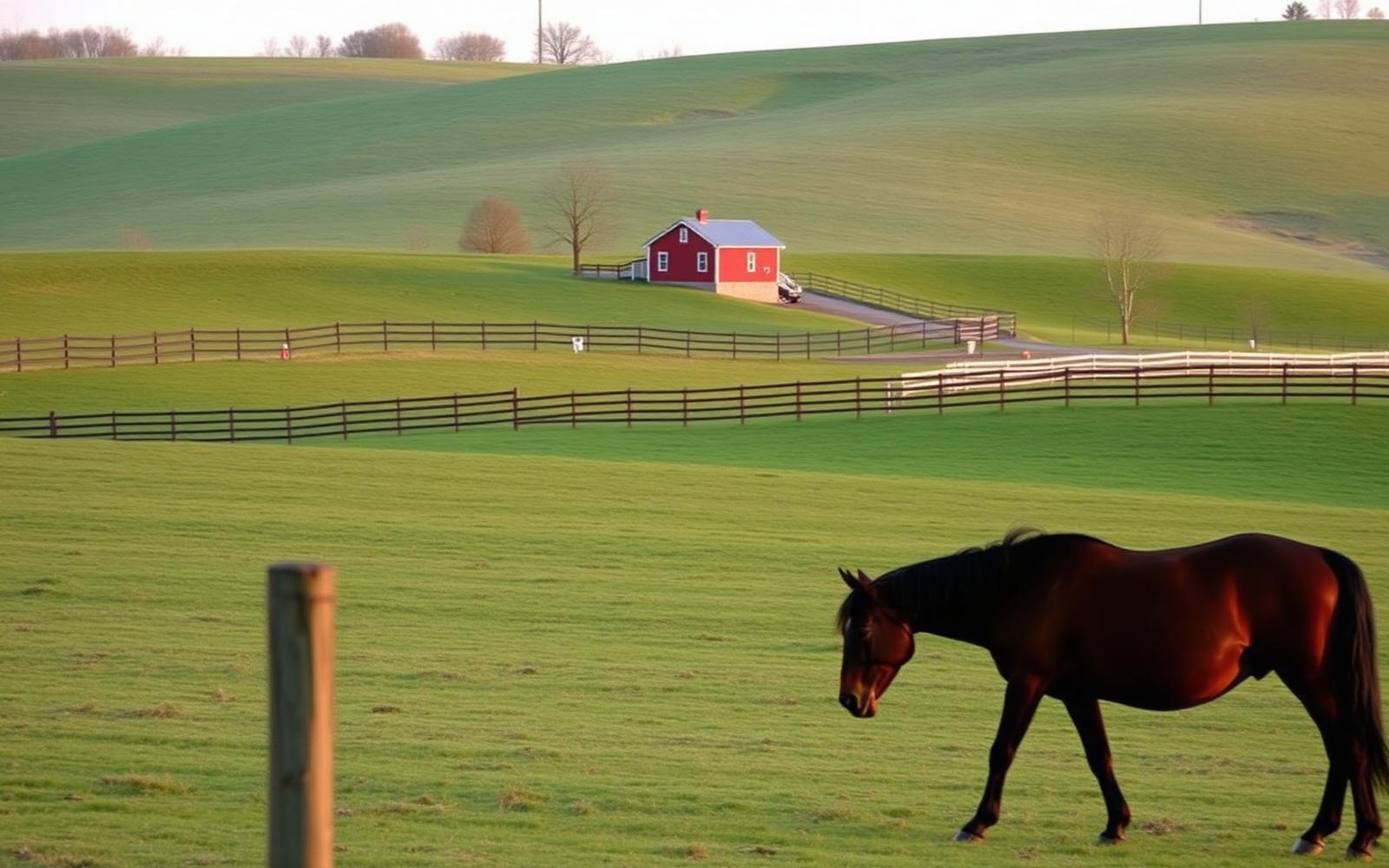
Half the land buyers I work with mention horses at some point. Some of them have owned them for thirty years. Some of them have never mucked a stall and are buying the dream. Both groups ask the same question, and the number they've read online is usually too simple.
The rule of thumb. Two acres of good pasture per horse is the standard answer for Middle Tennessee, and it's a reasonable starting point. That assumes decent fescue or orchard grass, rotational grazing, and normal rainfall. On that ratio, three horses want roughly six acres of usable pasture — plus room for the barn, the arena, the driveway, and the house.
Why "usable" is the operative word. A 12-acre parcel in Hickman or Lewis County can easily be four acres of pasture and eight acres of steep wooded hillside. That's a two-horse property, not a six-horse property. When you're evaluating acreage, walk it and count only the ground a horse can safely graze — not the ravine, not the cedar thicket, not the wet-weather creek bottom that stays boggy through March.
You can run tighter with a dry lot and hay. Boarding barns in Williamson County keep more horses per acre than the rule allows by feeding hay year-round and using sacrifice paddocks. It works, it's more expensive per month, and it's harder on the ground. If you want horses that live off your grass, respect the two-acre ratio. If you're fine buying hay, an acre and a half can hold a horse without destroying the pasture — as long as you rotate.
Water is the thing that gets missed. A horse drinks 5 to 15 gallons a day, more in August. If the property is on a well, ask about the well's gallons-per-minute rate, not just its depth. A 2 GPM well that's fine for a family becomes a real problem with four horses and automatic waterers. Frost-free hydrants at the barn are worth their cost the first February you own the place.
Fencing is the biggest number people forget. Four-board oak fence runs roughly $18–$30 a linear foot installed in this market, and perimeter fencing a 10-acre square is about 2,640 feet. Do that math before you buy the horses. No-climb woven wire with a top board is a common, cheaper, and honestly safer alternative. Barbed wire is what the cattle farmer left behind and it's the wrong fence for horses.
Zoning and greenbelt. Most rural Middle Tennessee counties have loose or no zoning, so keeping horses is rarely an issue outside city limits and subdivisions. Inside a city or an HOA, read the covenants — plenty of Williamson County subdivisions with "farm" in the name won't let you keep a horse. On the tax side, land in agricultural greenbelt requires 15 acres minimum and a genuine agricultural use; personal pleasure horses on 8 acres usually will not qualify, and the assessor will tell you so.
Where the horse properties actually are. Leiper's Fork and western Williamson County for the premium, well-fenced, ready-to-ride farms — expect to pay for the address. Thompson's Station and southern Williamson for the mid-tier. Maury, Hickman, and Lewis Counties for the same acreage at a fraction of the price, with the trade-off being drive time and, often, fencing you'll have to replace.
If you're shopping horse property, take me with you on the walk. I look at pasture quality, fence line, water, and how a trailer gets in and out — and those four things decide whether a pretty farm is actually functional. Text me at 310-872-8731.